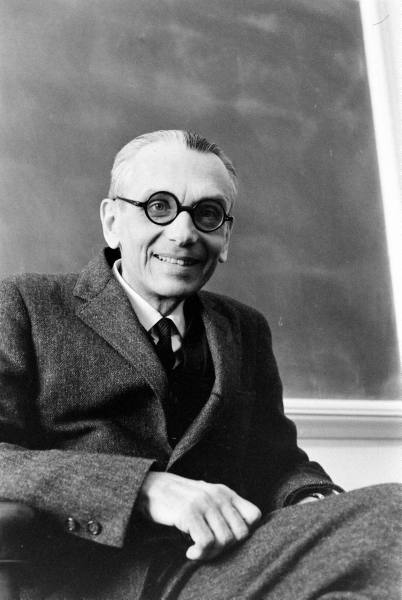
Kurt Gödel was a European mathematician who was born in Austria-Hungary, an area which is now known as the Czech Republic. He is known for his many scientific and philosophic works, as well as elaborating on Einstein’s theory of general relativity. As he grew old, he began to have periods of time in which he would be mentally unstable and become very sick. He developed an obsessive fear of being poisoned, so he would only eat food that his wife Adele made! Unfortunately for Gödel, in 1977 Adele was hospitalized for a six month period. Naturally, Gödel refused to eat and eventually starved to death. He died weighing 65 pounds. Learn more about this man by clicking the source
A domino can knock over another domino about 1.5x larger than itself. A chain of dominos of increasing size makes a kind of mechanical chain reaction that starts with a tiny push and knocks down an impressively larger dominos. A tiny domino that can hardly be seen can ultimately knock over a domino larger than the sun, if one could build dominos that large and stack them in order properly. The first domino may only be an a subatomic particle inside of an atom, which then bumps into an atom, which bumps into a molecule, which bumps into a small Nano sized dust mote, which then bumps into; you get the picture. If you want to see more, make sure you check the video in the source link! (Source)